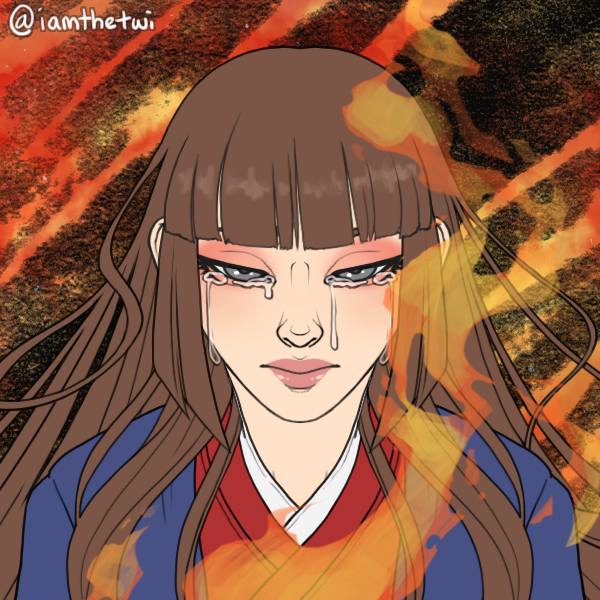
During this period, the Nishikaji Clan maintained uneasy relations with the great warrior clans of the era. Their weapons were highly sought after, and their neutrality made them valuable, but also vulnerable. As conflicts between major powers intensified, the clan began receiving increasingly urgent demands for armaments, forcing them into a position where their craft directly shaped the outcomes of war.
It was during the escalating conflict between the Uchiha and Senju that Tomoe’s life changed irreversibly. The Nishikaji were approached for an unprecedented political arrangement: a formal alliance with the Uchiha Clan, secured through marriage. Tomoe, chosen for her skill and composure, was designated as the bride in this agreement to ensure continued supply of high-grade chakra weapons and forging support for Uchiha forces.
Tomoe accepted the arrangement without protest. Not out of devotion, but out of understanding. It was a logical extension of her clan’s survival and influence. Through this union, she was introduced to Madara Uchiha, a man whose presence was defined by overwhelming ambition and unyielding conviction. Their relationship was not built on affection initially, but on mutual recognition of strength and purpose. Tomoe provided the Uchiha with weapons capable of sustaining prolonged conflict, reinforcing their battlefield effectiveness, while Madara ensured the Nishikaji’s access to rare materials and protection amid escalating war. In Madara, she saw a force of nature; in Tomoe, he saw precision capable of tempering that force. By the later stages of the war, their relationship had evolved into something understated but undeniable. Tomoe was no longer merely a contracted artisan in Madara’s orbit, and Madara was no longer simply a warlord she served. They had become two forces that, while still independent, had grown accustomed to moving in relation to one another.
Despite her proximity to one of the era’s most feared figures, Tomoe remained fundamentally unchanged. She did not become a warrior, nor did she take pride in the violence her creations enabled. Instead, she continued to define herself through her craft, often retreating into her forge where the world could be reduced to heat, metal, and control. However, the prolonged exposure to war gradually introduced an internal contradiction she never fully voiced. Each weapon she perfected extended the reach of conflict, and yet each failure in craftsmanship risked lives. She existed in a paradox between creation and consequence, shaping tools for destruction while believing in refinement and order.
As the Warring States Period drew closer to its end and the foundations of future villages began to form, Tomoe’s role became less visible but no less significant. Her work influenced not only Uchiha armaments but also early advancements in chakra-conductive metallurgy that would later define Nishikaji craftsmanship for generations. What remained consistent throughout her life was her identity: not as a warrior, not as a political figure, but as a creator bound to the edge of war, shaping steel in an age that refused to be still.
 Ninjibot