 Ninjibot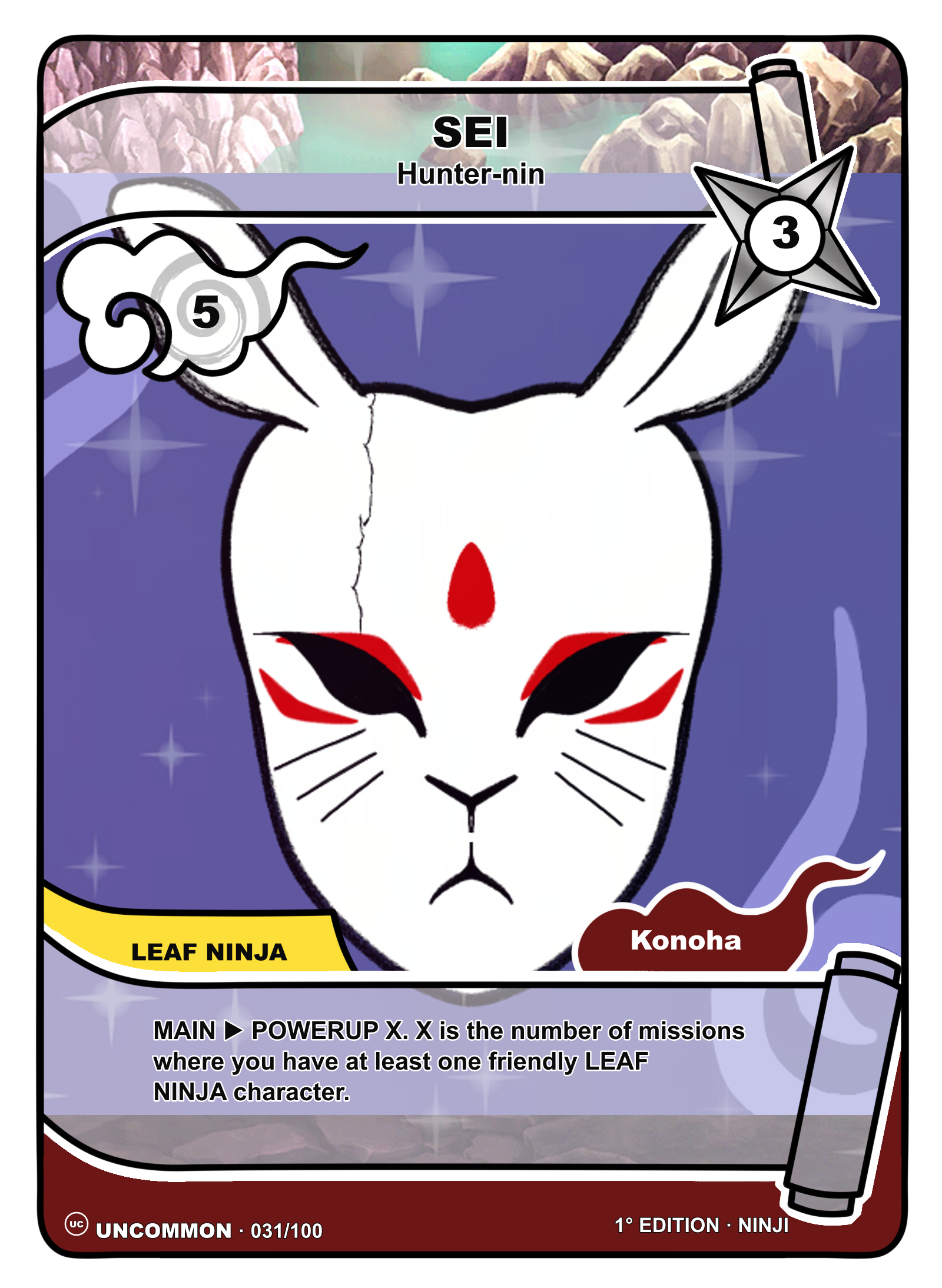

Sai
Friend

誓 means "vow, oath, pledge"
Sei was secretly removed from the Uchiha compound by Shimura Danzo’s Root prior to the clan’s massacre, identified as a potential asset due to their psychological profile and control aptitude. Listed among the dead, their existence was erased from official records. Unlike other survivors, Sei did not witness the massacre firsthand. Instead, they grew up in controlled isolation, resulting in a fragmented understanding of her clan’s fate.
A shadow among remnants, Sei represents a rare divergence from the Uchiha’s cursed legacy. Neither avenger nor restorer, they walk a path defined not by vengeance, but by survival.
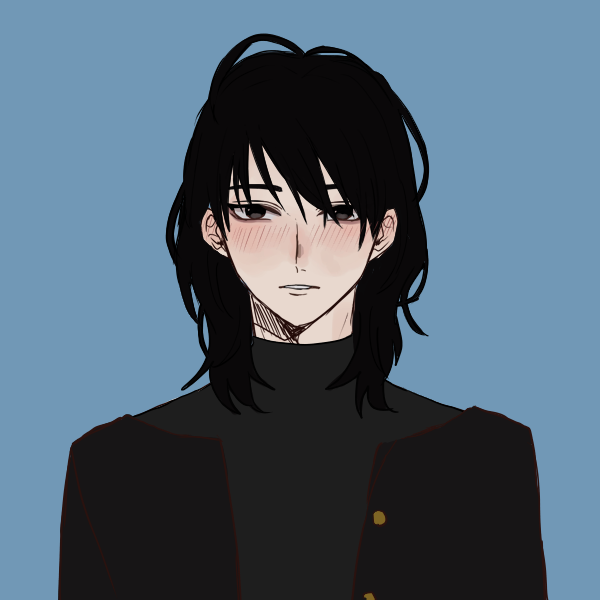
Profile

ANBU Mask
Bond: Sai
Black
Black
| Era | Height | Weight | Status |
|---|---|---|---|
| Part I | 152 cm (5'0") | 110 kg (243 lb) | Alive |
| Part II | 172 cm (5'8") | 60 kg (132 lb) | Alive |
| Blank Period | 172 cm (5'8") | 61 kg (134 lb) | Alive |
| Boruto | 172 cm (5'8") | 130 kg (287 lb) | Alive |
They are quiet, observant, and highly self-contained, shaped by years in Root where emotion was treated as a liability. Rather than becoming empty, however, Sei became selective: they feel, but withhold; they care, but rarely show it. Every reaction is measured, every word intentional. Silence is not absence for them, it’s control.
At their core, Sei values autonomy above all else. Their life has been shaped by systems that tried to define their purpose: first the Uchiha clan, then Root, then the broader shinobi world. As a result, they are deeply resistant to anything that feels like ownership or expectation. They don’t rebel loudly; instead, they disengage, redirect, and quietly choose their own path without asking permission.
| Positive traits | Neutral traits | Negative traits |
|---|---|---|
| Likes | Dislikes |
|---|---|
Observes before acting
Minimizes presence
Speaks with precision
Maintains controlled distance
Neutral Good
ISTP
Type 5 - The Investigator
Loss of autonomy
Being reduced to a tool again
Irreversible loss of self or identity
Forming attachments that can be exploited or lost
Never being a part of a family
Sei favors indirect engagement:
| Era | Ninjutsu | Taijutsu | Genjutsu | Fuinjutsu | Intelligence | Strength | Speed | Stamina | Hand Seals | Total |
|---|---|---|---|---|---|---|---|---|---|---|
| Part I | 3 | 2.5 | 3.5 | 1.5 | 3.5 | 1.5 | 3 | 2.5 | 3.5 | 24.5 |
| Part II | 3.5 | 3 | 4 | 2 | 4 | 2 | 3.5 | 3 | 4 | 29 |
Sei’s life doesn’t begin with the Uchiha massacre, but with something quieter; being overlooked. Within the Uchiha clan, she was not exceptional in the ways that were celebrated. She wasn’t loud, prideful, or driven by recognition. Instead, she observed. She watched how people moved, how they spoke, where their attention faltered. It wasn’t ambition that defined her early on, but awareness. And that awareness is what drew the attention of something far more dangerous than clan expectations: Root.
She was taken under the pretense of “evaluation.” No one openly resisted. At the time, the tension between the Uchiha and the village had already made compliance feel safer than defiance. It was framed as an opportunity. Advanced training, potential, a path forward. Sei accepted it without argument, but she remembered the look her mother gave her as she left: restrained, uneasy, as if there were words she couldn’t afford to say out loud. On the night of the Uchiha massacre, Sei was nowhere near the compound. She was in a sealed Root facility, cut off from the outside. Training continued as usual. No one told her what had happened. Not that day, and not the next. She learned indirectly, through fragments of overheard conversation, shifts in behavior, files updated in her presence without explanation. And then, just as suddenly, the Uchiha name stopped being mentioned at all.
She didn’t ask questions. By then, she understood what questions cost.
Her Sharingan awakened later, not in a moment of visible grief, but in a quiet collapse of understanding. The realization came slowly, then all at once: there was nothing left to return to. No home, no clan, no past that still existed. She didn’t cry. Not because she couldn’t, but because there was nowhere for that grief to go.
After the massacre, their role within Root shifted. They were no longer just another candidate, they were something retained, cataloged, preserved. But unlike before, their existence began to draw a different kind of attention, one that didn’t come from Danzo, but from above him.
Tsunade did not trust Root. She never had. Even before becoming Hokage, she understood what Danzo represented: a system that justified anything if it could be called necessary. Once she took the position, that distrust sharpened into something more practical. Root operated in the shadows of Konoha, technically under its authority, but never fully within its control. She needed eyes, not ANBU, not advisors, but someone inside.
Sei was not approached directly. That would have been too obvious and too dangerous. Instead, it began with subtle shifts. An assignment altered, a handler replaced, a report that didn’t quite follow Root’s formatting. Sei noticed, of course. The first real contact came as a message hidden within a report they were meant to deliver, a single line that didn’t belong: "If you can read this, you’re already outside their control."
They didn’t react immediately. Sei completed the assignment, returned the report, and continued as normal, but didn’t ignore it. The next message was clearer: a set of coordinates hidden within mission parameters, leading just outside standard patrol routes. They went, not out of trust, but out of necessity. The meeting was brief. An ANBU operative, masked and careful, spoke without ever saying Tsunade’s name. They didn’t need to. The offer was simple: not freedom, not escape, but purpose. Someone was needed to observe Root from within. someone already unseen.
Sei considered it logically. Leaving Root would make them a target. Staying would keep them a tool. But this gave them something different: a direction they chose for themself. When they finally spoke, it wasn’t acceptance in the usual sense. “I don’t report to you,” Sei said. The operative agreed. “You report what matters.” That was enough.
From then on, Sei remained within Root, but no longer as Danzo intended. They became an observer inside a system that believed it owned them. Sei didn’t sabotage missions or openly defy orders, that would have exposed them too quickly. Instead, they watched, listened, and remembered. Movements, deployments, unrecorded operations; things that never reached official channels. Sei passed information carefully, indirectly, never enough to reveal a pattern, always enough to matter.
By the time they act, the world has already shifted into the era of Shippuden: alliances fraying, missing-nin moving more freely, and Orochimaru’s influence still lingering despite his declining condition. For Tsunade, he remains a threat that can’t be ignored. For Sei, he’s something else entirely: a system built on control, not unlike Root... just more open about it. That makes him predictable, and worth watching.
Their “defection” is deliberate. Not loud, not desperate, just believable. Sei lets themselves be seen along one of Orochimaru’s outer routes, leaving behind just enough evidence of pursuit to suggest a shinobi fleeing Konoha’s reach. When they’re intercepted, they don’t resist. That’s what makes it convincing. People who truly defect rarely fight when they’re caught.
Kabuto evaluates them carefully. He notes the lack of records, the absence of a clear history, the gaps where information should be. Sei meets his scrutiny without resistance, answering only what’s necessary. When they say they were never meant to have a record, it shifts something, not trust, but interest. When they add that they’re no longer being told anything, it becomes enough. They are allowed in, not as a trusted ally, but as something potentially useful.
Orochimaru doesn’t meet them immediately. He observes first, letting new pieces settle before deciding their place. Sei understands that and gives nothing unnecessary. They integrate slowly into the hideout, accepting tasks and completing them with quiet precision. They never exceed expectations, never fall short. They move exactly as Root trained them to: efficient, controlled, forgettable.
But Orochimaru’s domain is different. Less rigid. More curious. That curiosity is what makes it dangerous. The hideout is filled with fragments—experiments, notes, incomplete work, lives reduced to data. Nothing is centralized. Everything feels intentionally scattered. Sei reacts to none of it outwardly, but they take it all in, committing details to memory with careful discipline.
Kabuto tests them often. Conflicting orders, subtle inconsistencies, moments designed to provoke hesitation. Sei gives him none. When he comments on their compliance, they respond by pointing out his observation. When he notes they don’t ask questions, they answer that they don’t expect answers. It’s enough to keep his attention without crossing into suspicion.
When Orochimaru finally appears, it’s without announcement. His presence fills the space quietly, but completely. Sei acknowledges him without overreacting, meeting his curiosity with controlled neutrality. When he remarks on their lack of fear, they respond that nothing here surprises them. It’s not true, but it’s not easily disproven. When he questions whether that comes from confidence or conditioning, Sei simply asks if it matters. The answer amuses him. From that point on, they are no longer just another defector, they are something to observe more closely.
Sei gathers intelligence the only way possible in a place like this: indirectly. They don’t search for answers. They notice patterns. Fragments of research, movements between hideouts, references to vessels and the persistence of the self beyond the body. Orochimaru’s goals aren’t hidden so much as scattered, and Sei pieces them together slowly, without drawing attention.
Then Sasuke arrives, and everything shifts. The atmosphere tightens, focus narrowing around him in a way that changes the structure of the hideout itself. Kabuto watches him carefully. Orochimaru studies him with open interest. The entire space begins to revolve around what he represents. Sei recognizes him immediately, not by appearance, but by presence. He doesn’t acknowledge them, or if he does, he gives nothing away. Their first interaction is barely that, a passing moment where his gaze lingers just long enough to suggest awareness. Sei adjusts accordingly, becoming even less visible. Sasuke’s presence makes information easier to gather, but far more dangerous to hold.
They continue passing information outward in fragments, using channels designed to avoid patterns. Nothing direct, nothing traceable. Always enough to matter, never enough to expose them. But staying becomes more difficult, not because of suspicion, but because of proximity. Sasuke is a reminder of what they didn’t become, and what they chose not to be.
Eventually, their paths cross without interruption. No one else is there, no need for pretense. Sasuke acknowledges them simply, noting that they shouldn’t be there. Sei replies that neither should he. When he states they’re working for Orochimaru, they turn the question back on him. That’s enough. No conflict follows, no attempt to push further. They both understand the situation for what it is: temporary, controlled, and destined to end. Sei leaves not long after. Not abruptly, not in a way that draws attention. A reassignment, a gap in presence, and then nothing. By the time Orochimaru’s focus narrows fully onto Sasuke, by the time everything begins to collapse inward, Sei is already gone. What they take with them isn’t just intelligence, but confirmation. No matter how different the system appears, Root, Orochimaru, anything built on control, it follows the same pattern.
And they refuse to belong to it again.
So Sei returns to the only role they’ve ever truly chosen. Not a weapon. Not a subject. Not a pawn. An observer watching from the edges, acting when it matters, and leaving before anyone realizes they were ever there at all. Sei remained within Root longer than anyone expected, long enough to understand its patterns, its limits, and its blind spots. And when the time came, when Danzo’s influence began to fracture and the system started to collapse, she didn’t stay.
He left the same way he had lived within it: quietly, intentionally, and on his own terms.
By the time Root fell, Sei was already gone. What he carried with him wasn’t just survival, but knowledge; the understanding that even within a system built on control, choice could still exist, small and deliberate.
Non-spicy OKThe creator welcomes non-spicy fanart of this OC without needing to ask first.
“No one asks why they survive. Only what they do now that they have.”
Autonomy, Survival, Belonging
Open in DiscordEdits on the dashboard do not change this post.